Fire Prevention Week runs October 4–10, and this year the message that matters most to anyone running a commercial kitchen in California is not about smoke detectors or exit signs. It is about the grease accumulating right now, above your cooking line, in the hood, the duct, and the fan — a fuel load that grows every single day the burners are lit.
What the fuel load actually is
Every time a burner fires, vaporized grease rises with the exhaust. Some of it escapes. Most of it does not. It cools against the baffle filters, the plenum walls, the inner surfaces of the duct, and the housing of the exhaust fan on the roof. There it thickens — slowly when volume is low, rapidly when the line runs hard. That accumulation is not a maintenance inconvenience. It is a combustible fuel load positioned directly in the path hot gases must travel to leave your building.
When a flare-up or an equipment malfunction introduces enough heat into that duct, the grease does not need an open flame to ignite. It needs only to reach its ignition temperature, and at that point the duct itself becomes the fire.
Five interconnected systems, not one
Kitchen leaders sometimes think of the exhaust hood as a single piece of equipment. The exhaust system is actually five components that must all be evaluated:
1. The hood — including the plenum chamber behind the filters
2. The baffle filters — the removable grease-separating elements
3. The duct — from the throat of the hood to the termination point at the roof or wall
4. The exhaust fan — motor, housing, and grease collection tray
5. The make-up air system — which affects how efficiently the others draw
Grease migrates through all five. A report that addresses only the visible hood tells a very incomplete story.
How California sets the inspection interval — and what triggers cleaning
This is the point where confusion costs kitchens money, time, and, in a claim or investigation, credibility.
The edition of NFPA 96 adopted in your jurisdiction sets how frequently the system must be inspected — and that frequency is determined by cooking volume and the type of fuel and cooking equipment in use. A high-volume solid-fuel operation is inspected on a different schedule than a low-volume gas operation. The standard lays this out in a table keyed to cooking type and volume.
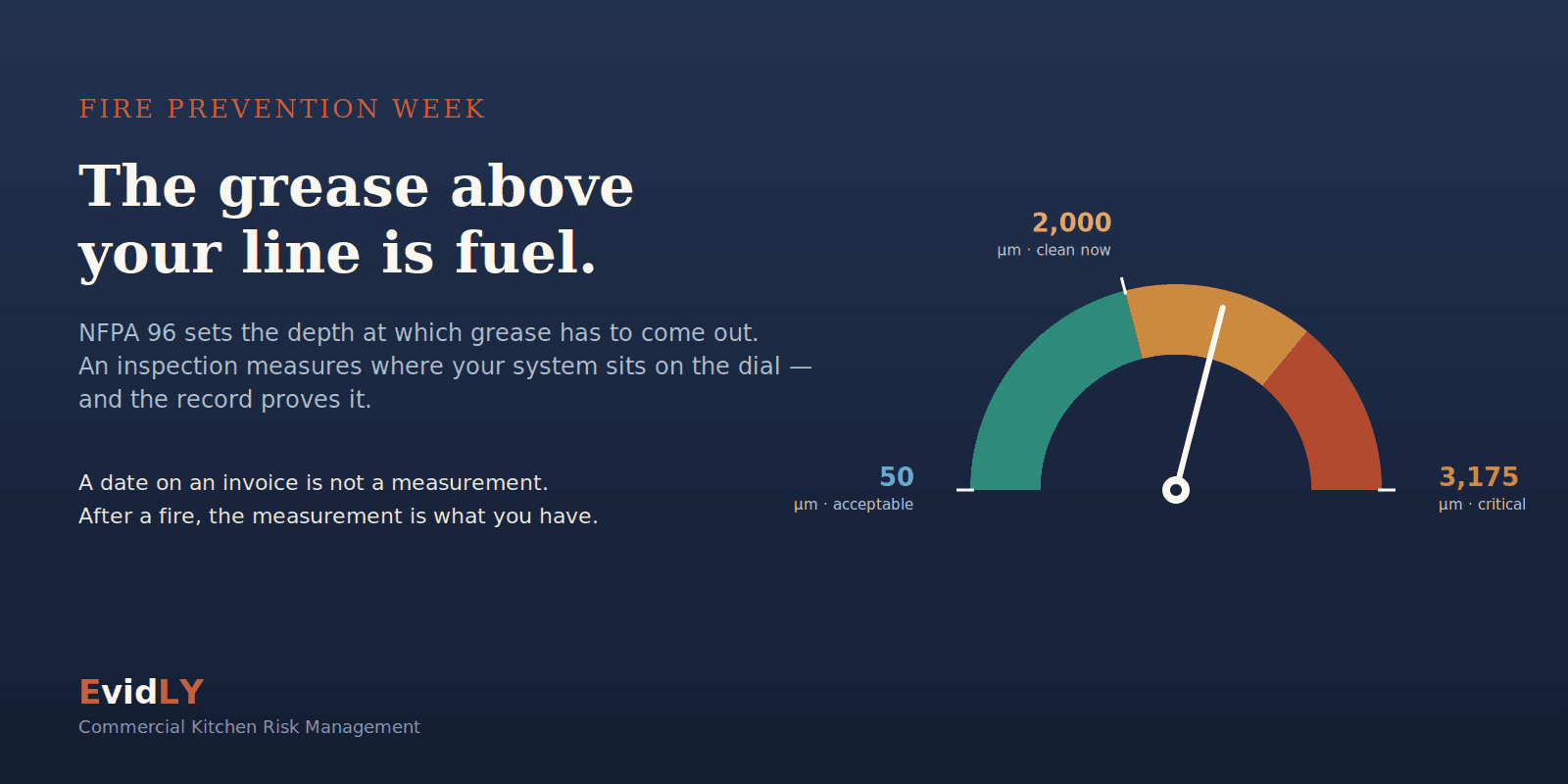
Cleaning is a separate question. Cleaning is triggered by what the inspection measures. The standard specifies grease-depth thresholds — expressed in microns. Surfaces are cleaned to remove combustible contaminants to a minimum of 50 microns — that is how clean is clean enough. A measured depth of 2,000 microns on a surface of the exhaust system, or 3,175 microns in a fan housing, is the point at which cleaning is required.
What this means practically: a kitchen that was cleaned six months ago is not necessarily clean today. And a kitchen that received service last month may already be at a threshold if the volume ran hard. The inspection interval tells you when to look. The measurement tells you what the look found.
What California's regulatory environment adds
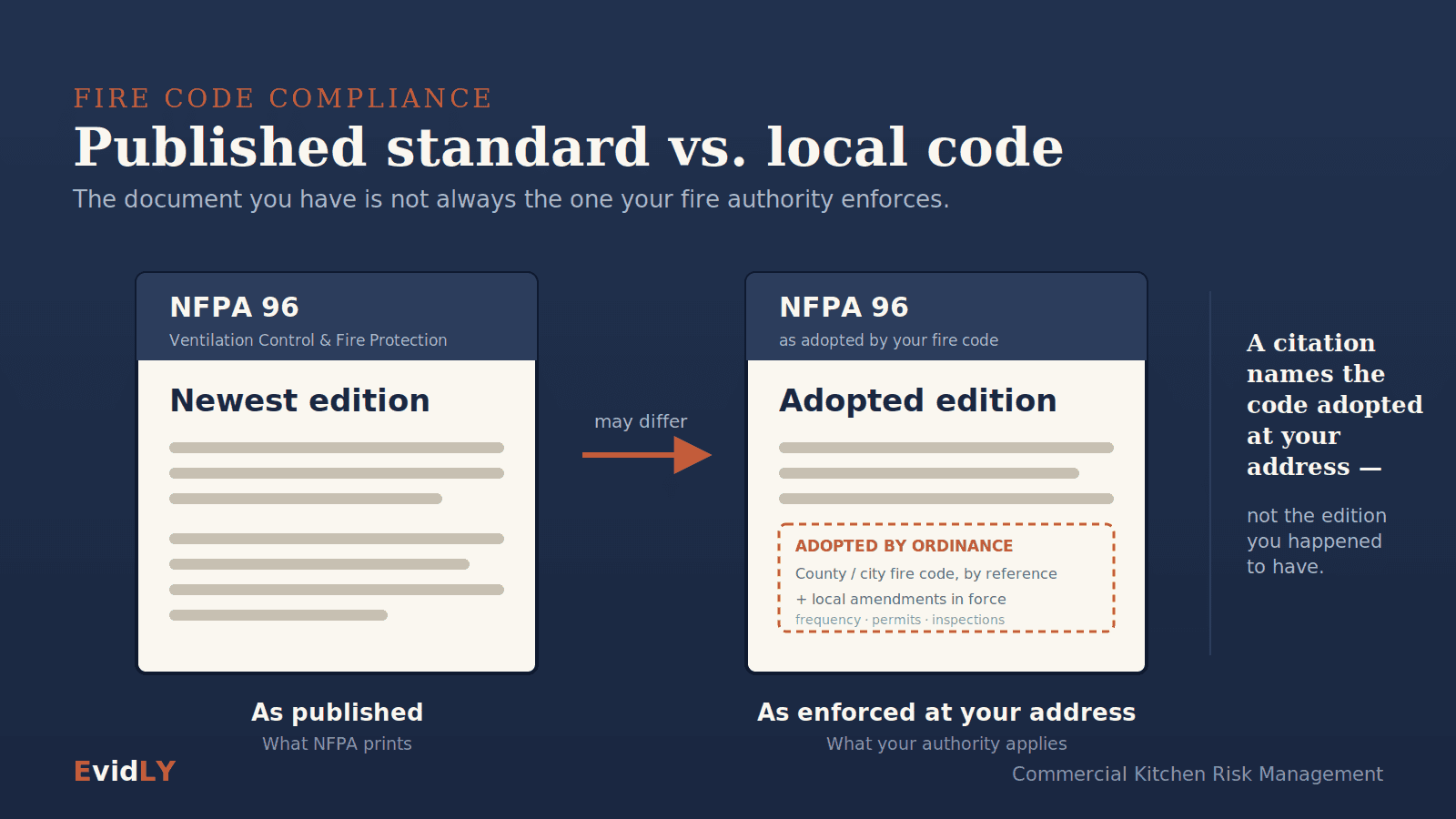
California kitchen leaders operate under a layered set of obligations. The California Fire Code incorporates NFPA 96 by reference — use the edition adopted in your county, because adoption is not uniform across all California jurisdictions, and local amendments apply. Your local Authority Having Jurisdiction — typically the fire marshal or fire prevention bureau — has the authority to interpret and enforce these requirements. That authority includes the right to inspect your records, to require documentation of service intervals, and to require corrective action when documentation is missing or deficient.
This matters because after a fire event, the record you hold — or do not hold — becomes evidence. An adjuster, a fire investigator, or an AHJ examining the cause and origin of a kitchen fire will look at the service record. If the record shows a date but no measurement, it documents that someone was present. It does not document that anyone measured anything, found any specific condition, or determined that any threshold was or was not exceeded.
A date with no measurement is not a clean bill of health. It is a gap.
What a report has to show for it to mean anything
A service report that will hold up — to an insurer, to an AHJ, to any post-incident review — needs to show more than a signature and a date. It needs to show:
- Which of the five systems were accessed and evaluated
- The grease depth found at each measurement point, in microns
- Which points met the threshold and which did not
- What action was taken at each point that required action
- The condition at completion, not just at arrival
- The credentials of the person who performed the work
On credentials: Cleaning Pros Plus holds IKECA membership as a company. The founder holds CECS #200452 personally. The crew are PECT Designated Technicians. Those are the credentials CPP holds. Whether any specific credential satisfies a requirement under the standard adopted in your jurisdiction is a determination your AHJ makes — not a claim any service company should be making for you.
The record after a fire
If a fire originates in or travels through the exhaust system, the first question an investigator asks is when the system was last serviced and what was found. The second question is whether the service record reflects actual measurement or simply the fact of a visit.
California kitchen leaders who have invested in regular Kitchen Exhaust Cleaning and can produce measurement-based records are in a materially different position than those who have a stack of dated invoices with no supporting data. The record is not a formality. After an event, it is one of the few things you control.
This week
Fire Prevention Week is a reasonable time to pull the most recent service record for your exhaust system and ask a simple question: does this document what was measured, or only that someone showed up?
If the answer is the latter, that is not a settled matter. It is an open one.
Take Risk Assessment: getevidly.com/risk-assessment