Your kitchen was serviced. You have something on file. The question nobody asks until it matters is whether that something answers the questions it will be asked.
Who asks, and what they ask for
Four parties ask for your exhaust records, and they do not ask the same way.
The fire marshal asks when the system was last inspected and to what standard. The insurance adjuster asks, after a loss, whether the system was maintained on the interval the policy required. A property manager asks before a lease renewal, usually inside a broader document request. And a health inspector, there for other reasons, reads the hood too.
All four accept a document. Only one kind of document survives all four.
A date is not a record
An invoice with a date proves you paid someone. A service record proves the work met a standard. Those are different claims, and the gap between them is where kitchens get caught.
A complete kitchen exhaust service record shows five things: the date, the scope of what was serviced, the grease depth measured, the condition the system was left in, and the name of the person who did the work. Drop any one and the record answers a narrower question than the one being asked.
The measurement is the part most records are missing
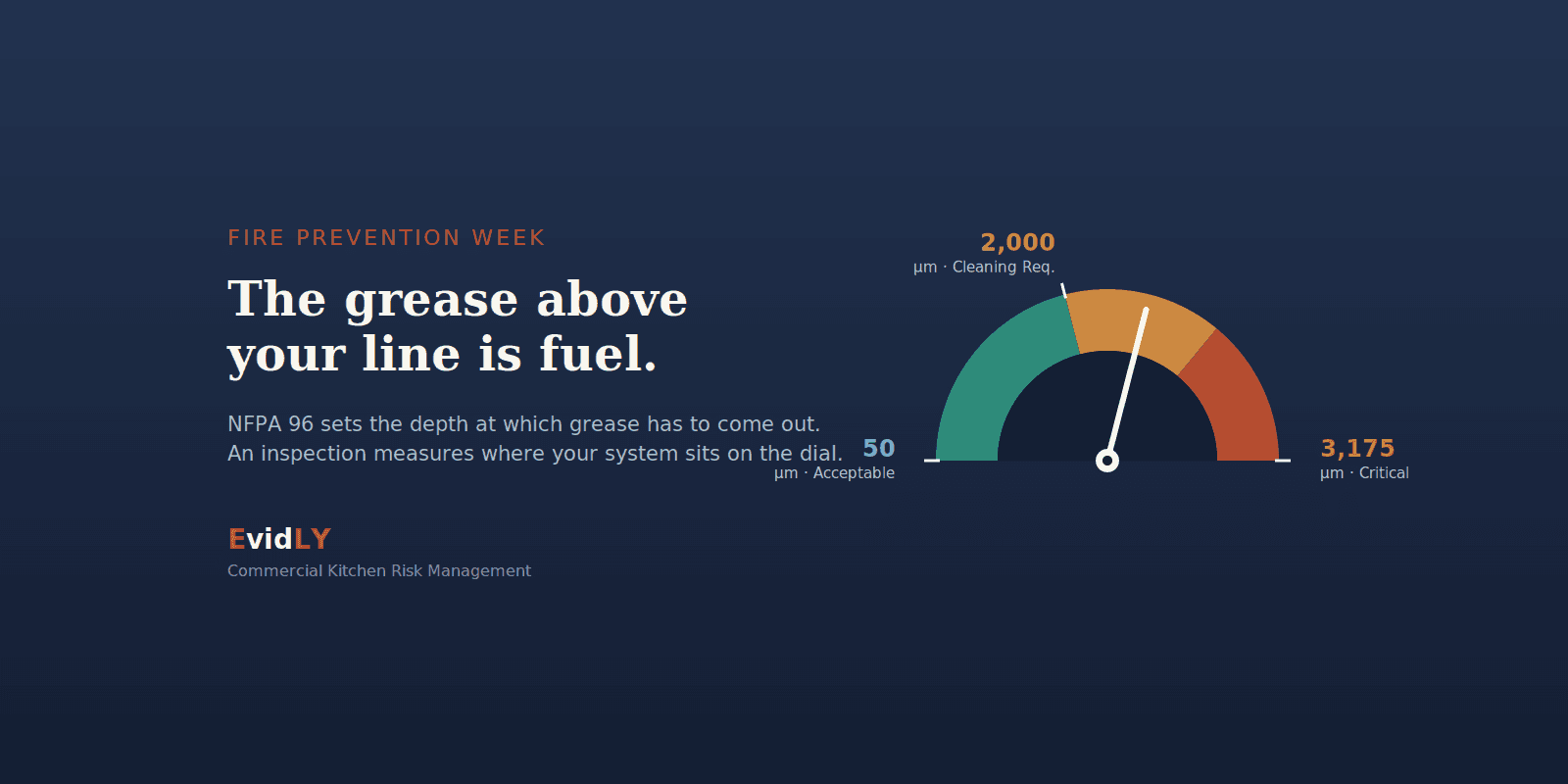
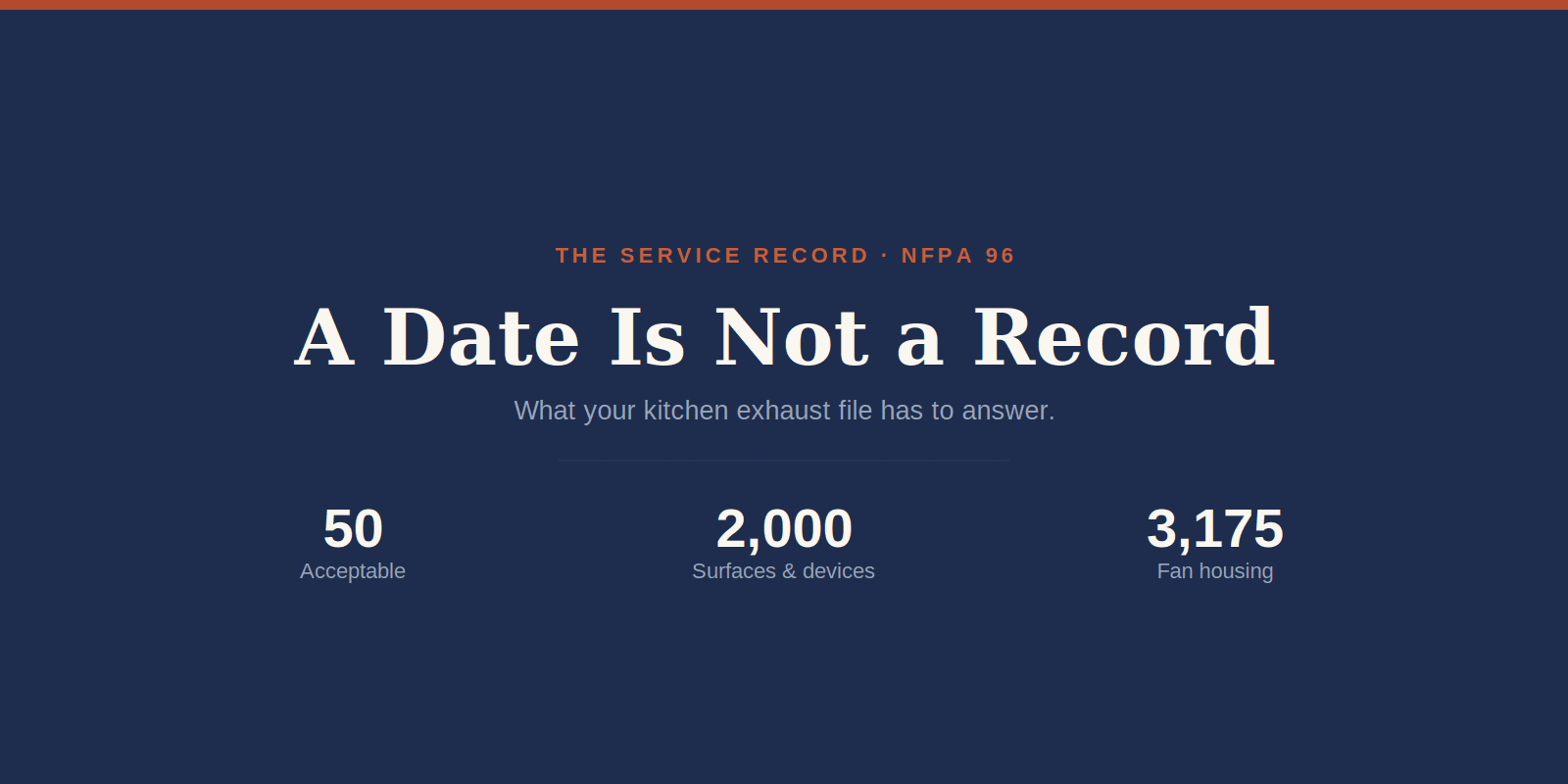
NFPA 96 sets the inspection interval by cooking volume and the equipment on the line, and triggers cleaning separately — on grease depth measured with a depth gauge comb. At 0.078 in. (2000 μm) the surfaces are cleaned; in a fan housing the figure is 0.125 in. (3175 μm); and cleaning removes contaminants to a maximum of 0.002 in. (50 μm).
That makes the reading the pivot of the entire record. Without it, the document cannot say whether cleaning was required, whether it was performed in response to a finding, or whether the system was within limits when the technician left.
Look at your last report. If there is no number, it records a visit, not a condition.
The interval belongs on the record too
A record that names the interval — and the cooking classification it came from — answers the next question before it is asked. A solid-fuel kitchen on a quarterly cycle is operating at three times the interval the standard assigns it, and the usual cause is misclassification: nobody wrote down what the kitchen cooks on.
If your record names your classification, a reviewer checks it in seconds. If it does not, they have to ask, and asking turns a file review into an investigation.
Producible, not merely existing
The last property of a real record is the one people discover too late: you have to be able to produce it.
The test is simple and worth running this week. Try to produce your last hood cleaning report and certificate in five minutes, without calling the vendor. If you can, the record is yours. If you cannot, it belongs to somebody else's filing system, and it will be unavailable at exactly the moment it is requested.
That holds for all five of your fire systems, not only the exhaust. Suppression, sprinkler, alarm and extinguisher each run on their own interval and each leaves a record — and after an incident they are requested together.
What to do this week
Open your most recent exhaust service report and check it against the five: date, scope, depth reading, condition left, technician. Note what is missing. Then time yourself producing it.
The three-minute risk assessment shows you which of your kitchen's records you could send today.