Fire Prevention Month is here. If you run a commercial kitchen, this is the right month to stop treating Kitchen Exhaust Cleaning as a checkbox and start treating it as a documented cycle — fuel load measured, interval set, record kept, next date confirmed.
Here is what that means in practice.
The Fuel Load Is Real and It Accumulates
Every time a burner fires, grease-laden vapor rises into the exhaust system. Some of it condenses on the interior surfaces of the hood, the plenum, the duct, and the fan. That condensate is fuel. It is not theoretical. It is measurable in microns of grease depth, and it builds on a schedule that has everything to do with what you cook and how often you cook it.
The national standard that governs commercial kitchen fire safety — NFPA 96 — sets inspection intervals based on cooking volume and cooking type. A solid-fuel operation runs at a different inspection frequency than a low-volume kitchen using only electric equipment. The inspection interval is how often a qualified technician must look at the system. The cleaning trigger is what that inspection actually finds.
Those are two different things, and confusing them is how kitchens end up with a report dated twelve months ago that says nothing about what was actually measured.
The Five Systems That Must Be in the Record
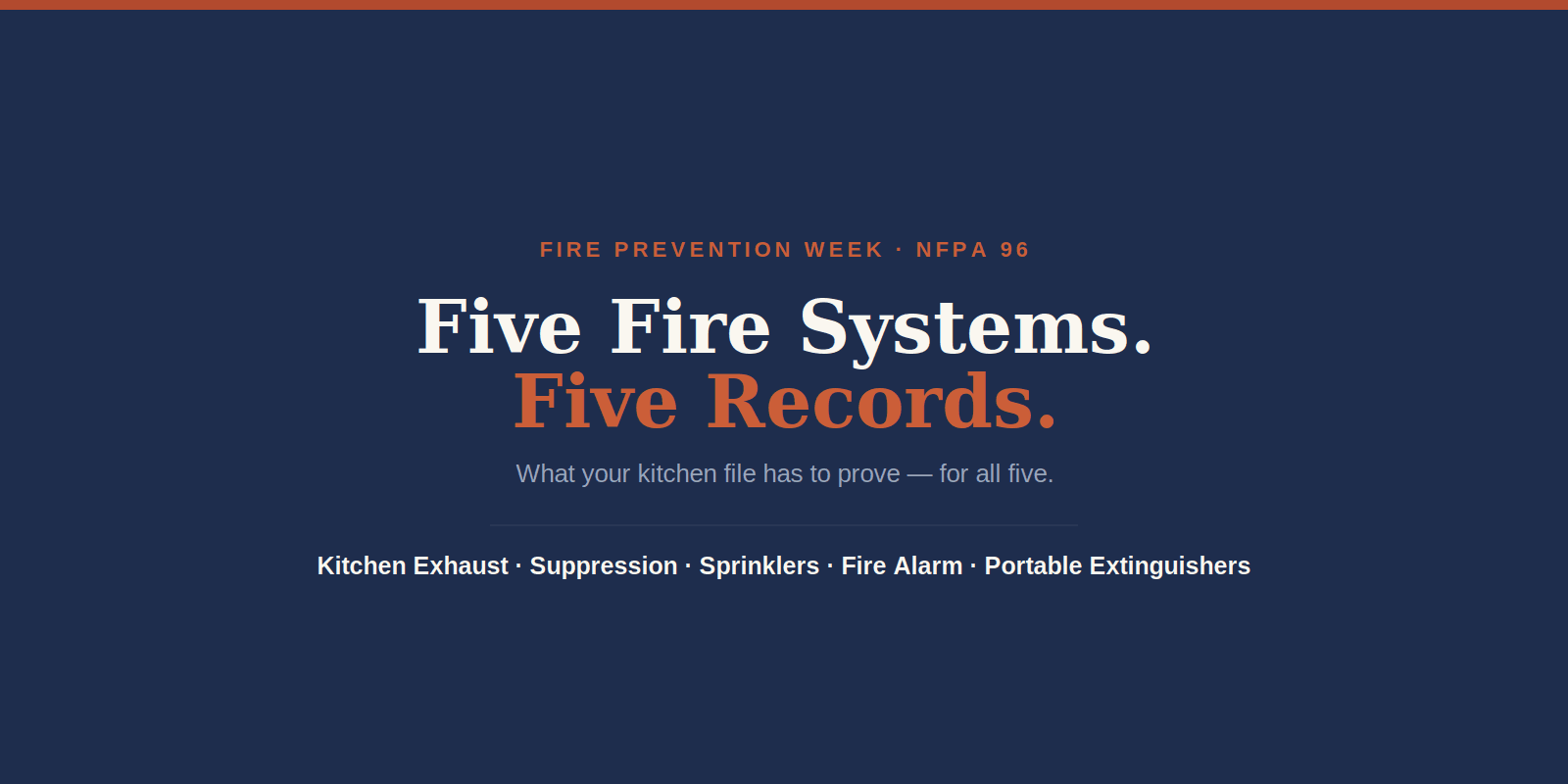
A Kitchen Exhaust Cleaning visit is not a single act. It is a coordinated inspection of five interconnected systems, and a report that omits any one of them is incomplete.
1. The Hood and Plenum
The collection point for grease-laden air. The plenum — the space between the filters and the duct collar — is where grease accumulates fastest and where a fire can establish itself before it enters the duct. It must be cleaned to bare metal or near-bare metal, not wiped down.
2. The Ductwork
Everything between the fan and the hood collar. Duct runs that include horizontal sections, offsets, or access panels that were added by a previous contractor deserve particular attention. Grease pools in low points. The report must reflect the condition found, not just the condition after cleaning.
3. The Exhaust Fan
The fan is both a mechanical component and a grease-collection surface. A seized bearing is a mechanical failure. A grease-packed fan wheel is a fuel load issue. Both matter. The report should address both.
4. The Makeup Air System
Makeup air and exhaust are a matched pair. A system that exhausts without adequate makeup air creates negative pressure that degrades capture velocity. Capture velocity degrading means grease-laden air escapes into the kitchen rather than entering the duct. If makeup air is not addressed in the report, the cleaning of the exhaust side is only half the picture.
5. The Suppression System
The fire suppression system — typically a wet chemical system — must be inspected by a licensed contractor on its own schedule. Kitchen Exhaust Cleaning does not substitute for suppression inspection, but the KEC technician should note anything that suggests the suppression nozzles are obstructed, that access panels have been sealed over, or that the system has been modified since the last inspection. Those observations belong in the record.
What a Report Has to Show for It to Mean Anything
A report that says "system cleaned" and carries a date proves one thing: someone was present. It does not prove what was found, what depth of grease triggered the cleaning, or whether the system was brought to an acceptable condition before the technician left.
A report that means something shows:
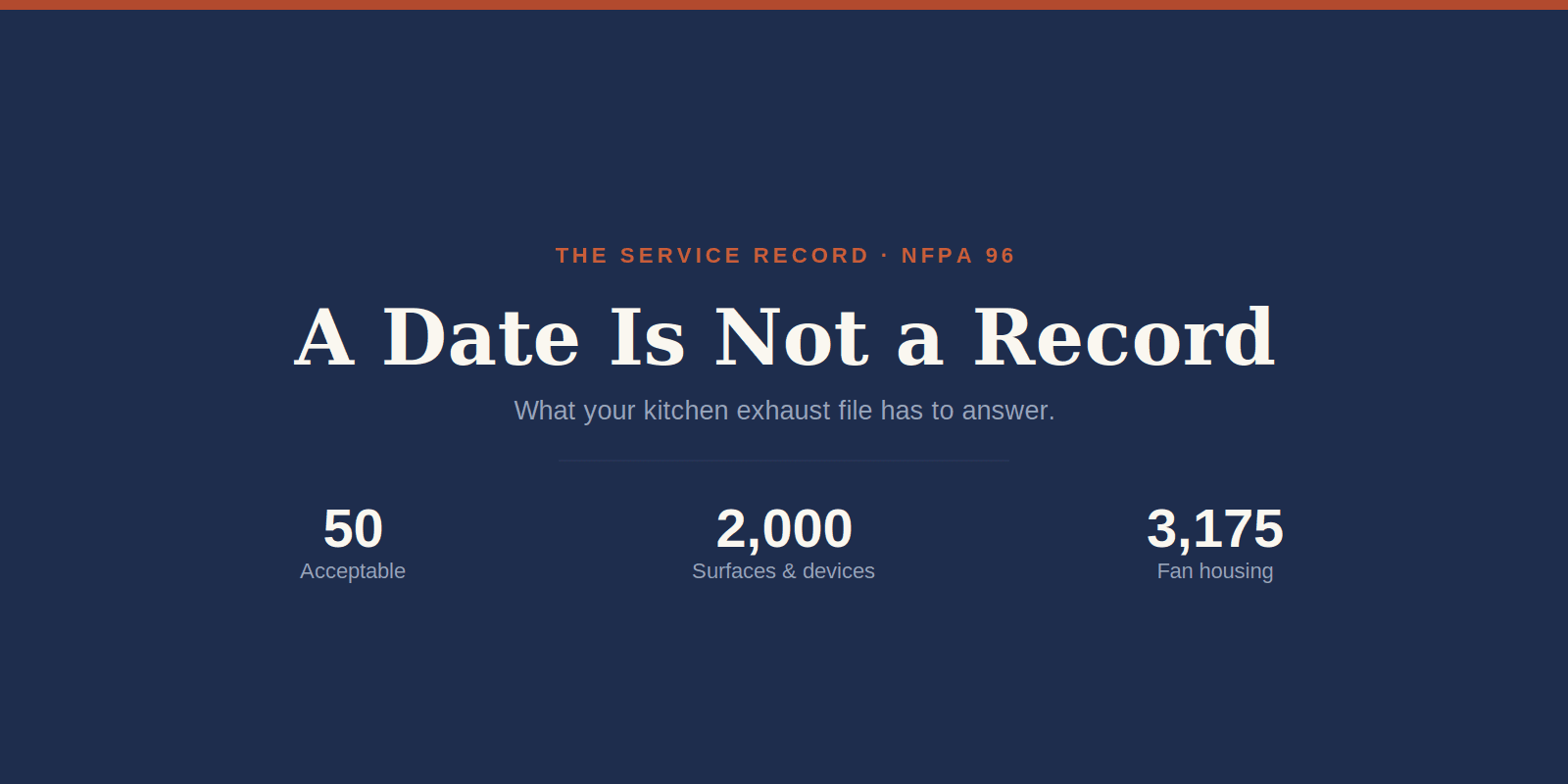
- Grease depth measurements before and after, in microns — the thresholds set by NFPA 96 are 2,000 microns as the cleaning trigger, 3,175 microns as the point at which a fan housing requires cleaning, and 50 microns as the acceptable condition after cleaning
- Which sections of duct and plenum were accessed
- What access was not possible and why
- The condition of the fan, including any mechanical concerns
- The next recommended inspection date, set by what was found — not by a default calendar
If your current report does not contain measurements, it is not a record of condition. It is a record of attendance.
The Record After a Fire
If a fire occurs in a commercial kitchen — whether it is a flare-up contained by the suppression system or an event that causes structural damage — the documentation of the exhaust system's prior condition becomes material.
Your insurance carrier will ask when the system was last inspected and cleaned. Your state fire marshal's office has authority over commercial kitchen fire safety in your state. Local jurisdictions may adopt their own amendments to the fire code, which means the authority having jurisdiction — the local fire marshal or fire prevention bureau — may apply requirements that differ from the statewide baseline.
A report with measurements, dates, technician credentials, and a next inspection date tells that story. A sticker on the hood does not.
Your State's Regulatory Layer
Most states have adopted a fire code that incorporates the provisions of NFPA 96 governing commercial cooking equipment, ventilation, and fire suppression. The edition adopted in your county is the controlling reference — and because local jurisdictions may amend or locally adopt their own edition, the authority having jurisdiction for your specific address is the party you must consult to confirm the applicable edition and any local amendments.
That means the inspection interval that governs your kitchen is not a national average. It is a function of what you cook, how often you cook it, and which edition of the code your local AHJ has in force.
What a Date With No Measurement Proves
Nothing.
A next-inspection date written on a report that contains no pre-cleaning measurements proves that someone intends to return. It does not prove the system was in acceptable condition when they left. It does not prove the system is in acceptable condition now. It certainly does not prove, in the event of a loss, that due diligence was exercised.
The date matters. The measurement is what gives the date meaning.
Set the Date This Month
Fire Prevention Month is a useful prompt, not a deadline. The actual deadline is set by the inspection interval that applies to your kitchen under the code in force in your county.
If you do not know that interval, that is the first thing to establish. If you know the interval but cannot produce a report with measurements for the last visit, that is the gap to close.
The record exists to tell the story of a system that was inspected, measured, cleaned to a documented condition, and scheduled for its next visit. Every commercial kitchen should be able to produce that record on request — from an insurer, from an adjuster, or from a fire marshal.
EvidLY is about that record: what it must contain, what it currently contains, and what it is missing.