Fire Prevention Week runs October 4–10. If you run a commercial kitchen, this is the right moment to stop and ask a question that has nothing to do with how clean your hood looks: does your file actually prove what it needs to prove, for all five fire systems that protect your kitchen?
Most kitchen leaders think about fire safety one system at a time, usually right before an inspection visit or right after something goes wrong. This week is the argument for thinking about all five at once — because each system runs on its own interval, each is supposed to leave its own record, and a lapse in any one of them is a lapse the whole operation carries.
The Five Systems and Why They Are Not Interchangeable
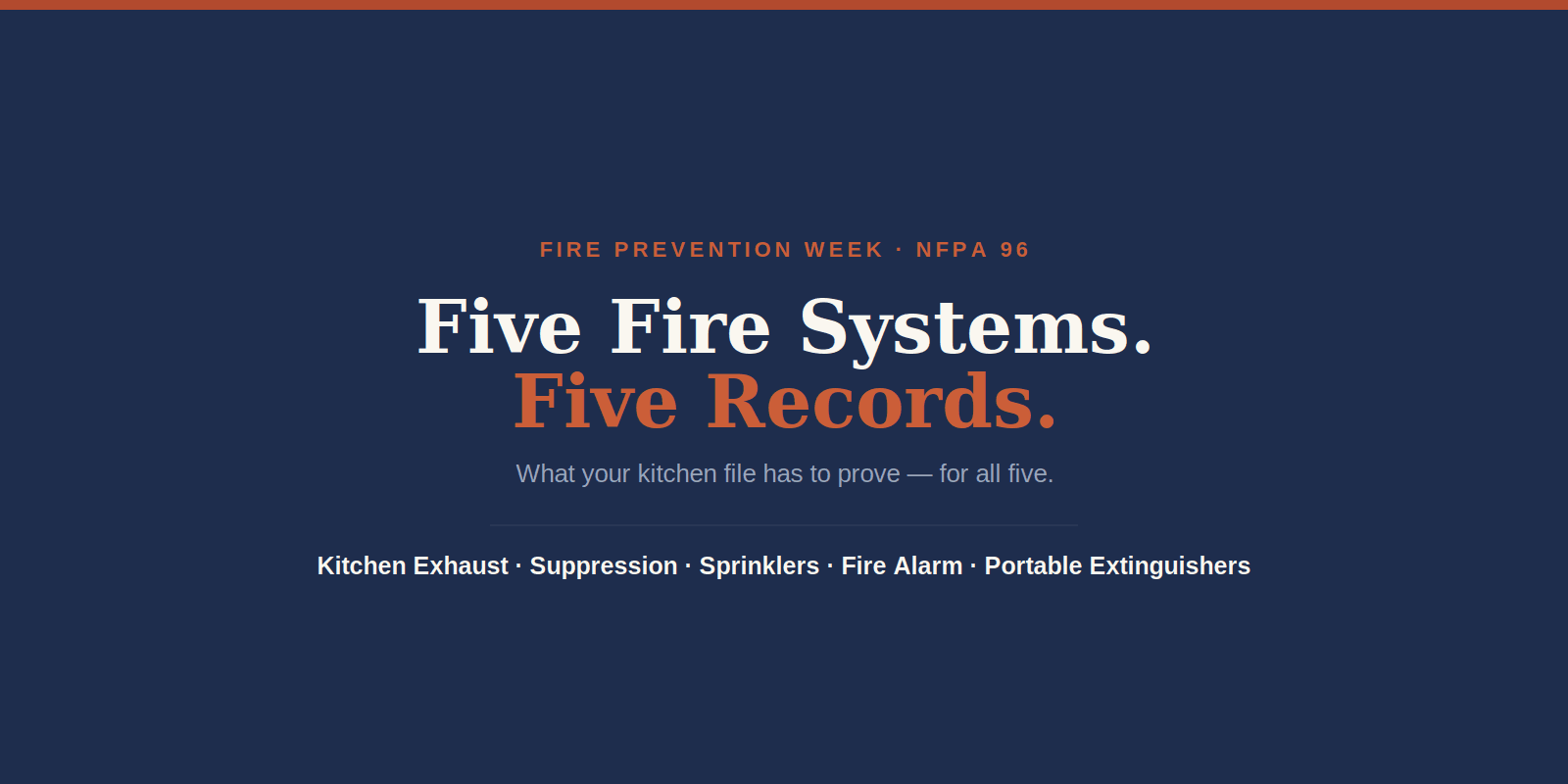
A commercial kitchen runs five distinct fire systems. Each one does a different job, each one is governed by its own service interval, and each one is supposed to produce a document after every service visit. They are not substitutes for one another, and a current tag on one does not speak to the condition of the others.
1. Kitchen Exhaust Cleaning (KEC)
This is the system most kitchen leaders think about most — and the one where the record is most often misunderstood.
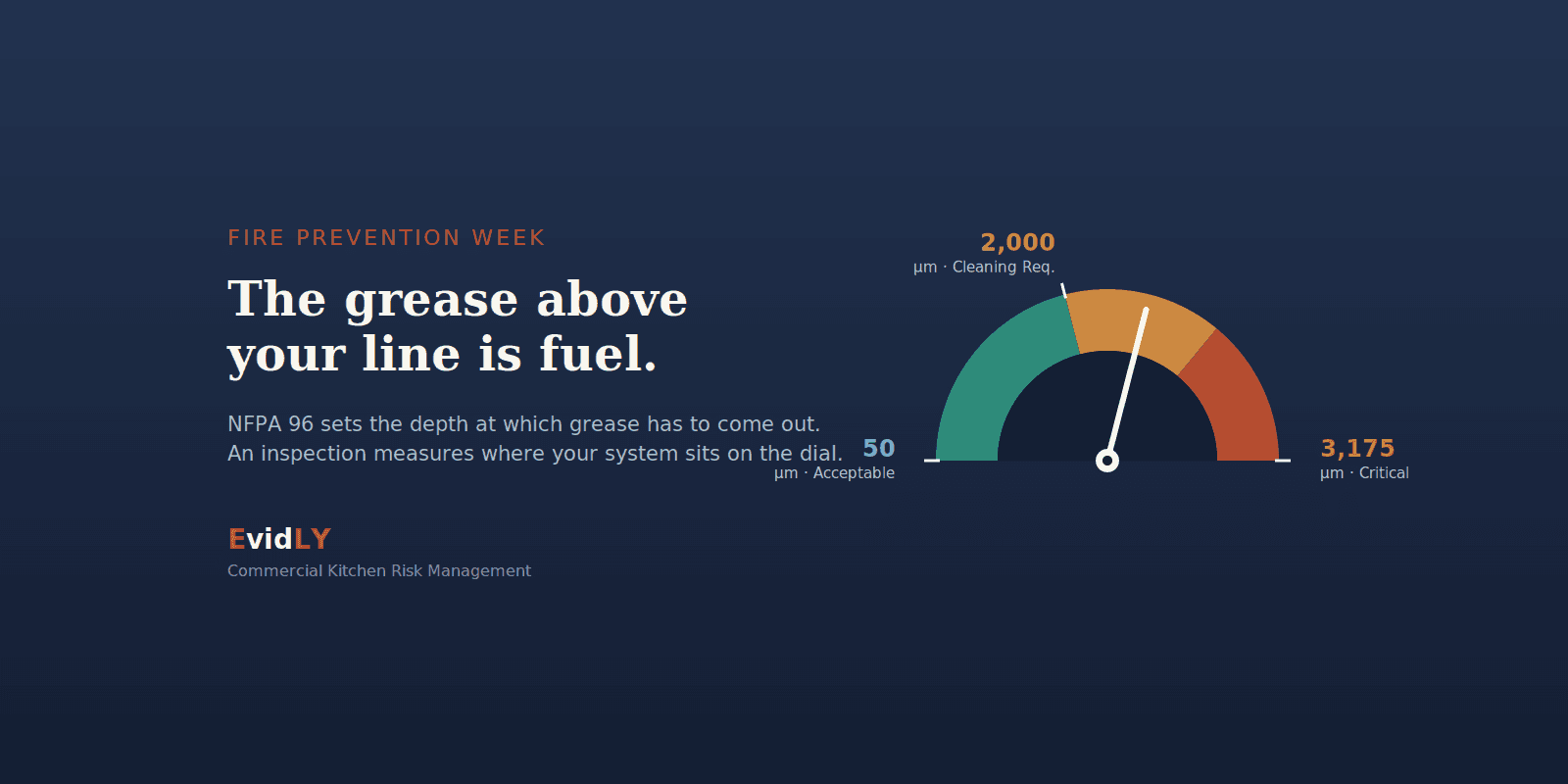
The exhaust system accumulates grease. Grease is fuel. The relevant standard — NFPA 96 — establishes how often the system must be inspected, based on cooking volume and fuel type. That inspection interval is not the same thing as a cleaning schedule. Cleaning is triggered by what the inspection measures. If grease depth at the inspection date exceeds the threshold the standard sets, cleaning is required. If it does not, the record should say so and give the measured depth.
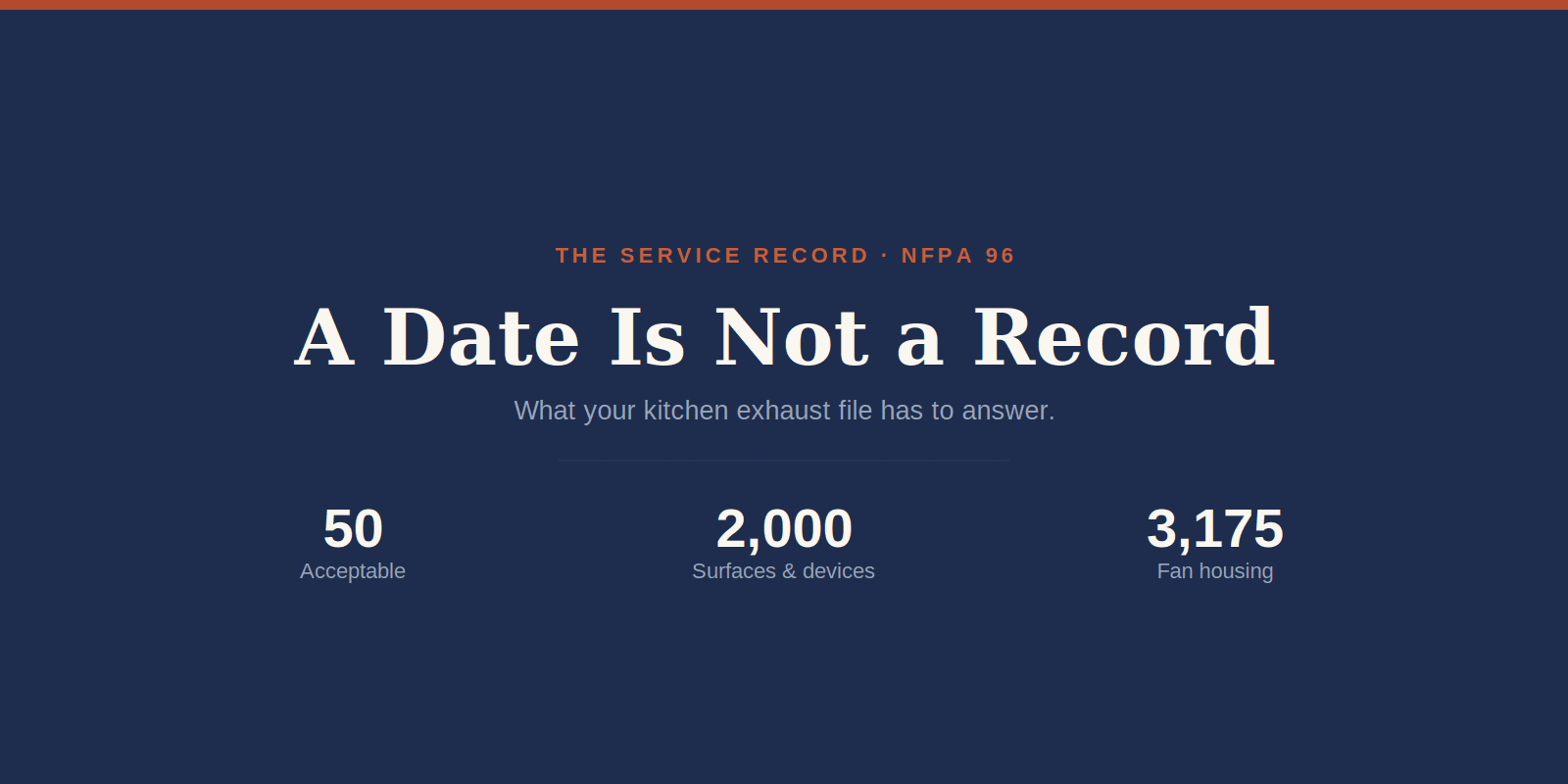
The three grease-depth figures that matter in this context are 50 microns, 2,000 microns, and 3,175 microns. A service record that does not include a measured depth is a date on a page. It is not evidence that the system was ready.
The edition that applies to your kitchen is the one adopted by your local authority having jurisdiction — confirm that locally.
Cleaning Pros Plus, LLC is an IKECA member. The founder holds CECS #200452 personally, and the crew includes PECT Designated Technicians. Cleaning Pros Plus, LLC performs the work and reports what it measured. The record is yours to keep.
2. Automatic Fire Suppression
The suppression system — typically a wet chemical system mounted in the hood — is what activates when a fire starts at the cooking surface. It is inspected and serviced on its own interval, by a licensed contractor, and it produces its own tag and its own report.
The relevant standard for restaurant fire suppression systems is NFPA 17A. The service interval it establishes is separate from anything KEC requires. A kitchen that just had its exhaust cleaned last month may still have a suppression system that is past its service date. The two systems do not reset each other.
Suppression system inspection and service are required under the fire code your jurisdiction has adopted. What the authority having jurisdiction may do if that service has lapsed — including what conditions may trigger a notice or a closure — is governed by that code and local ordinance.
3. Automatic Sprinklers
If the building has a sprinkler system, it operates under yet another interval and yet another inspector. NFPA 25 governs the inspection, testing, and maintenance of water-based fire protection systems, including sprinklers. The fire code your jurisdiction has adopted incorporates this standard, and the inspection cadence it sets is not the same as KEC or suppression.
Sprinkler records are building records as much as they are kitchen records. Kitchen leaders who lease their space should know whether the building owner is maintaining those records and whether copies exist in the file the kitchen actually controls.
4. Fire Alarm System
The fire alarm system — detectors, pull stations, annunciators, and the panel — is tested and inspected under NFPA 72. The testing interval, the testing method, and what the record must show are all specified by that standard.
A fire alarm inspection report that simply records a pass/fail without specifying which devices were tested and what the results were is not a complete record. If an authority having jurisdiction ever reviews your file after an incident, the detail in that report matters.
5. Portable Fire Extinguishers
Extinguishers are the only one of the five systems that is designed to be used by a person in the room. They are inspected annually by a licensed contractor and receive a monthly visual check. The standard that governs them is NFPA 10.
The annual inspection tag is the most commonly seen piece of fire documentation in any kitchen. It is also the one that is most often treated as proof that all five systems are current. It is not. It proves only that the extinguisher was serviced. It says nothing about suppression, sprinklers, alarms, or exhaust.
The Record After a Fire
This is the part kitchen leaders rarely think about until it is too late.
If a fire occurs in your kitchen, every authority that responds — the fire marshal, the insurer, the authority having jurisdiction — will ask for your service records before they ask almost anything else. Those records are not looked at to confirm that you did your best. They are looked at to establish whether the system was in a required state of readiness at the time of the fire.
A tag with a date answers one question: when was someone last there? A report with measurements, technician credentials, findings, and deficiency notes answers a different set of questions — the ones that actually matter when something has gone wrong.
A record that cannot answer those questions is not a record. It is a date.
What This Week Asks of Kitchen Leaders
Pull all five files. Not the tags on the wall — the actual reports. Check the date on each. Check whether the report contains findings or just a signature. For your KEC record specifically, check whether grease depth was measured and recorded.
If a file is missing, thin, or carries a date that has lapsed, this week is the week to address it — not because Fire Prevention Week is a deadline, but because the five intervals do not pause while you are thinking about it.